
Get in touch. Promise we won’t bite.
Contact usor feel free to connect:
by Ninedots on Jul 1, 2025
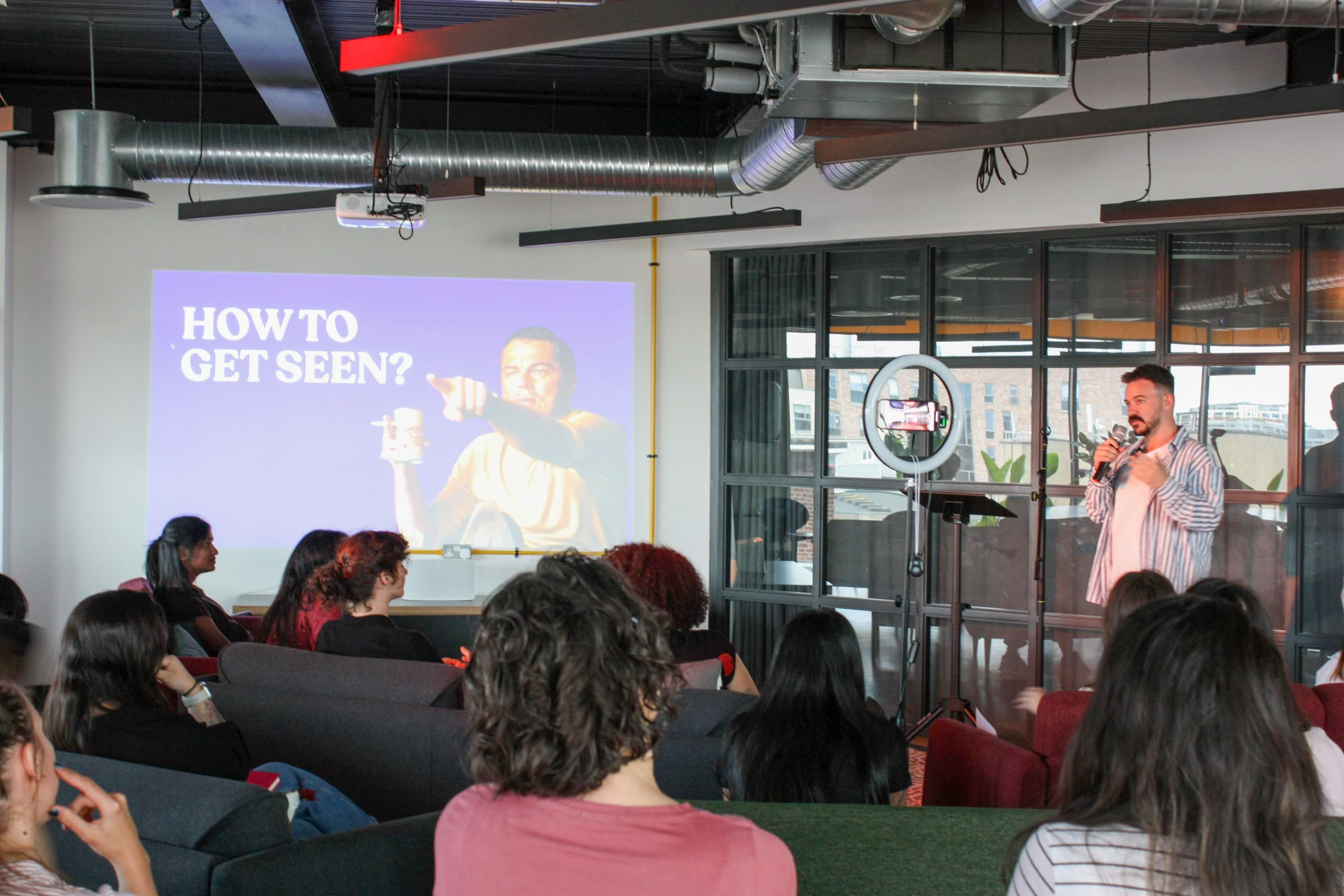
Our very own Lee gave a talk at Ladies that UX this month on the design market in Ireland currently. As promised, here's a video of the full talk, and answers to some of your burning questions:
There isn’t a one-size-fits-all approach to this, unfortunately. We would definitely advise starting with an open mindset.
Depending on how long you have taken a break for, it’s highly likely that you will be asked about it, so it’s good to prepare for that.
Side projects are a great way to refresh your skills and show what you can do. If you’re a designer you can include these in your portfolio, if you’re an engineer you can put them in your Github. Make sure to show your processes and outline the reasons you chose to do things the way you did. Companies always want to understand the why and how just as much as seeing the finished product.
Network! It can definitely be daunting stepping back into the workforce after a break, but if you go to Meetup events you can not only refresh your knowledge, but meet people too. Some companies will share if they are hiring, or you could end up meeting someone who knows of an opportunity. The more you’re out there the more you’ll build your personal brand because you’re not just a CV. Stay active on LinkedIn too, not just for applying to jobs, but building your personal brand and connecting with people.
We’d advise including a note if you send connection requests. This helps stand out that bit more than just sending a request with no context!
It may take time. The market is very competitive, and there are a lot of people applying for jobs, but if you build up your personal brand and continuously work on your skills, it will happen. You may need to take a course, depending on how long you haven’t been working, to help you upskill. Technologies and tools are always changing, so this way you can make sure you’re using the latest versions.
When you do get an interview, make sure to prepare! Know who the company is and what the details of the position are. We have two interview prep guides on our website, one is design specific and the other leans more towards technical positions. They’re worth taking a look at!
There are a few things here!
We’ll start with sponsorship, as that’s probably the first thing to consider. This really varies from company to company, as the most likely companies to offer sponsorship would be the multinationals, but with that comes (generally) a higher level of applications.
Some smaller companies will sponsor too, but it’s not something that they necessarily advertise. Generally speaking, if you’re working with a recruiter they will either know if sponsorship is an option or they can at least ask. Unfortunately, while sponsoring is a relatively straight-forward process, not every company will do it (for a variety of reasons, which is a post in itself).
With all of this being said, when you’re applying for a job, just be honest about your visa status. If you need one, say it! If you have one, say that too. It’s much better to be upfront about this, rather than spending time interviewing and going through a whole process, only to find out that the company can’t offer you a visa. Even if you’re the perfect person for the position, that doesn’t tend to have an impact when it comes to companies being open to sponsoring or not.
The one thing we’d advise is to start building a network here. Go to the meetups, get to know people in the industry. People are always willing to help (and yes, that includes recruiters!)
Your experience sounds great. The combination of UX and Engineering isn’t incredibly common, so from a skills perspective (at least without having seen your portfolio) it seems that you are in a strong position experience-wise.
It’s not necessarily a disadvantage, but it can be confusing to the person who is reviewing your CV and portfolio if they don’t understand design. Design has matured so much over the years, but if the person reviewing your application doesn’t understand the nuances then that can make things difficult.
As an example, let’s say a recruiter is reviewing your application. They may or may not understand the differences between UX and UI, they may not understand how accessibility ties in, or they see the mention of front-end development and assume you’re not a designer. Of course there are plenty of recruiters who do understand all of this, but it’s just an example of someone who isn’t the hiring manager who could be looking at your application.
This is where your portfolio really needs to highlight clearly what you can do. We would advise you to segment your portfolio into clearly identifiable categories. Where do we go to see your UX projects? Where can we see your visual design? When we land on your portfolio what do we see?
The same way a book consists of chapters, your portfolio should consist of sections which clearly show the different areas of design you work in.
One thing that could come up, and this is unique to each company’s own requirements, is exactly the depth of experience they would need in a particular area.
Let’s say a company needs a UX Designer who has about 5 years of experience. You have six years of design experience, but have only been doing UX for two. Even though you have what they need in terms of duration, the responsibilities of their role may be outside of what you have done in those two years.
It’s not a disadvantage to be multi-skilled at all, but it can be confusing for people to understand your experience if it’s not clearly represented. When it comes to working with recruiters, for example, we need to work with the requirements that our client has given us for their role. That’s why they work with us - to help them with their requirements. There are a lot of times when a recruiter can understand your work, can see your experience and potential, but if the company hiring for the role says no, then it’s out of our control. It’s not the recruiter saying “No, you’re not good enough”, it’s that the company has specific requirements that we need to work with.
What we would recommend in this situation is to make sure that your portfolio is categorised. There are so many people who are multi-skilled, and really what sets them apart is being able to clearly represent their experience in different areas because, as we all know, UX is not UI. Visual Design is not UX, and the list goes on!
Tell them, it’s that simple! There is absolutely no reason to avoid that question, because you need to be paid :)
It’s much better to say what your salary expectations are, rather than going through a process and getting an offer for a job that pays €20k less than what you want.
There are a lot of times where the “What are you looking for VS what are you paying” conversation comes up, but in the end there’s no reason to avoid this. You are either comfortable with their salary range or not, and they either have approval for your salary expectation or they don’t.
What your salary range should be is something you can take guidance on, but ultimately it’s down to you to determine what you are comfortable with.
Let’s take an example and say you earn €55k. You are looking for a new job and you know for a fact that you can’t go below earning €55k because we all have bills! That’s your baseline. Let’s say you would like to earn more, because who doesn’t?! So you aim for €60k.
Your range is then:
€55k if a role absolutely ticks all of the boxes, has the progression you want and is an opportunity you’ve waited for forever. Your own personal situation determines if moving to a new role for the same salary (or even a lower salary) is right for you. Sometimes you do need to take a step to the side to be able to take a step forward.
€60k is what you want and what you’re aiming for. Maybe it’s €65k, this is just an example.
It means that, in this example, you have €5k wiggle room.
You know what you want, and you know what you can’t go below, and you have room to negotiate if you need to.
Ultimately, as much as we love Instagram, we wouldn’t recommend avoiding or reverting the salary question. It’s important!
Honestly, we don’t have the answer to this. We wish we did!
It’s probably safe to say that with the continued growth of AI it’s highly likely that UX will be heavily intertwined with it. Maybe AIX (AI Experience)?
We don’t think that UX will disappear, though. As AI will continue to grow, it's quite likely that there could be a movement back to face to face and human interaction. As to whether we think that means that UX Designers have to become UX Engineers - we’re not sure. We have seen these titles before, but looking at the actual job descriptions it’s a front end leaning Engineer who can collaborate closely with UX Designers.
UX with a Business Development mindset? That in itself depends on the definition of what business development is in each company. If it means sales, then we’re looking at how UX can increase sales in a company.
It goes without saying that UX impacts a person’s interaction with an app/ site/ product etc, which in turn leads to sales. We don’t think they’re separate, necessarily. Good UX means a good product, which increases sales.
If we look at business development as more of an overview of the business, and how UX can help further grow an organisation, the same applies in a sense. If someone is building a company, and understands the importance of their user’s experience, then that impacts the overall business.
From what we have seen, there does seem to be a general movement towards “doing more with less”. A lot of companies are looking for multi-skilled people, where they can potentially hire one person who can cover a couple of areas. We don’t necessarily think that a UX Designer now needs to learn how to code, but with AI being so commonplace it’s likely to change in its application. Off the top of our heads, when we think of AI, we think of:
LLM - Large Language Models. How will UX intertwine here?
RAG - Retrieval Augmented Generation. Think of the responses from ChatGPT, that’s a generated response from AI. Even though ChatGPT will learn through constant use, it still needs to generate a response. User experience does need to be part of that, otherwise people wouldn’t use it.
VR - There are so many companies out there doing this! Companies setting up VR gaming spaces in cities, so here in particular the user experience needs to be of the highest quality. UX in the VR space isn’t new, but we think that will keep growing.
It’s difficult to predict what’s coming next, but by keeping an eye on trends in the market we can start to make more informed movements on what lies ahead.
If you have any questions- drop them here! Follow us on LinkedIn for more updates and advice on the Design Market in Ireland!